
The AI Infrastructure Divide Is Reshaping Global Markets
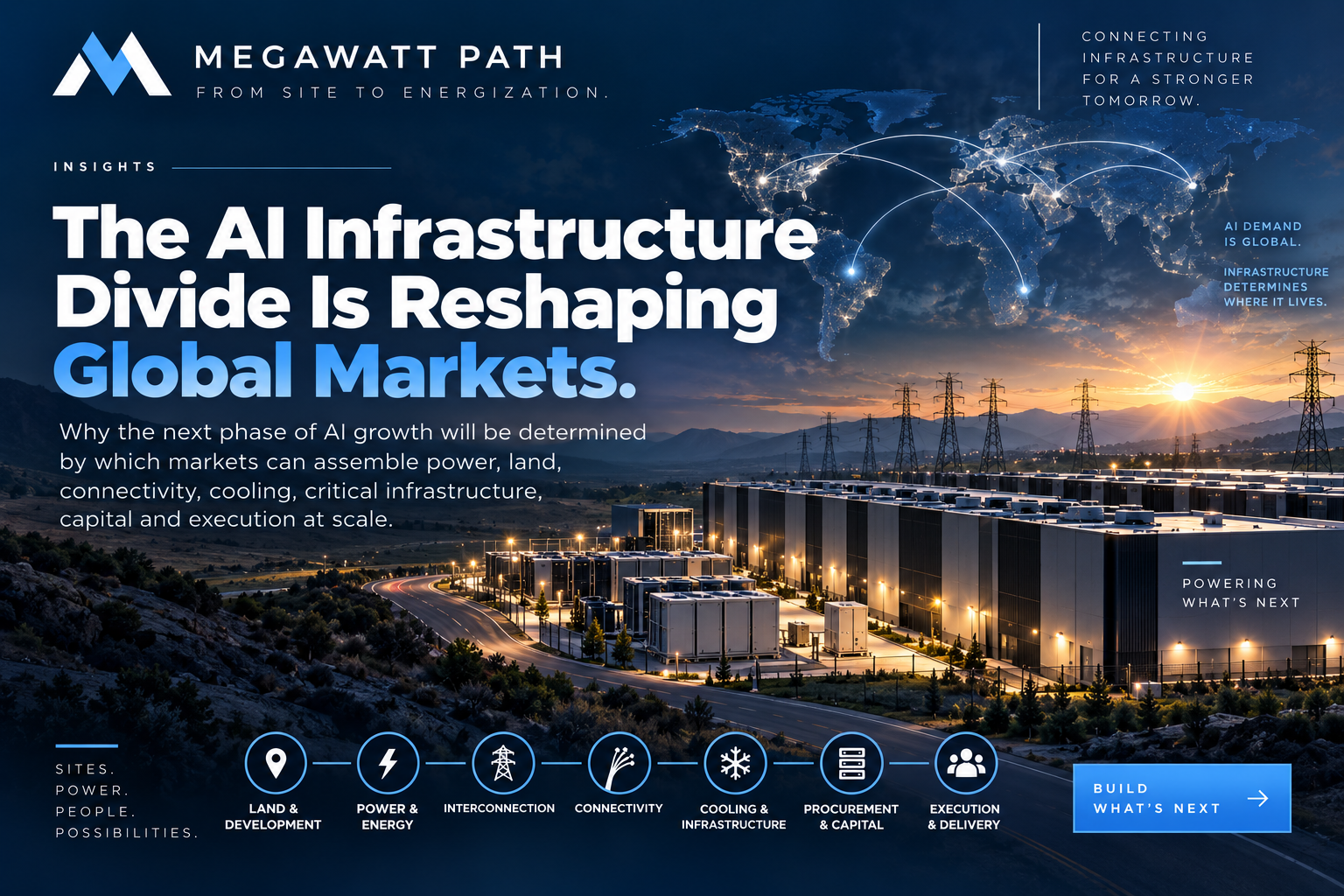
Why the next phase of AI growth will be determined by which markets can assemble power, land, connectivity, cooling, critical infrastructure, capital and execution at scale.
By Megawatt Path | Infrastructure Insights | September 2026
Artificial intelligence is usually discussed as a race for better models, more advanced chips, larger clusters and greater access to capital.
But underneath that competition, another race is taking shape.
It is physical.
Every AI workload ultimately has to run somewhere. Every accelerator has to be energized. Every rack has to be cooled. Every campus has to be connected. Every megawatt has to travel through real electrical infrastructure. Every facility requires equipment, construction, approvals, capital and a development schedule capable of bringing all of those pieces together.
That reality is creating what we call the AI Infrastructure Divide: the widening gap between markets capable of assembling the physical infrastructure required for AI-scale computing and those that cannot do so within a commercially viable timeframe.
This divide will not simply influence where data centers are built.
It could influence where capital flows, where new infrastructure ecosystems emerge, which communities attract investment, which utilities become strategic development partners and, ultimately, where the next generation of AI computing capacity can actually exist.
The AI economy may be digital.
Its constraints increasingly are not.
We Are Entering the AI Infrastructure Constraint Era
The first phase of the AI boom focused heavily on compute.
Advanced GPUs and accelerators were scarce. Model performance increased rapidly. Technology companies competed aggressively for chips, talent and capital.
Those inputs remain important.
But the bottleneck is moving outward from the server.
A company may secure thousands of GPUs and still need a facility capable of supporting them. That facility requires electricity, grid infrastructure, cooling, fiber, electrical equipment, construction capacity and potentially new generation.
At sufficient scale, these requirements become infrastructure-development problems.
The question is therefore changing from:
Can we obtain the compute?
to:
Where can the compute actually be deployed, energized, cooled and connected on the required timeline?
That is a very different question.
And it has the potential to reshape markets.
Defining the AI Infrastructure Divide
The AI Infrastructure Divide is the widening separation between markets, sites and development ecosystems that can assemble the complete physical infrastructure required for AI-scale deployment—and those that may possess demand, land or capital but cannot bring the necessary infrastructure together fast enough.
This is important because infrastructure readiness is not determined by one variable.
A region may have inexpensive land but insufficient grid capacity.
Another may have abundant generation but limited transmission.
A site may have strong power potential but inadequate fiber diversity.
Another may have land, power and fiber but face difficult entitlement timelines.
A developer may solve those problems and still encounter transformer, switchgear or cooling-equipment lead times.
And a technically viable project may still fail to reach construction if its capital structure cannot accommodate the infrastructure required before revenue begins.
The divide therefore extends across an interconnected stack:
Power & Energy → Interconnection → Land & Development → Connectivity → Cooling & Critical Infrastructure → Procurement & Capital → Execution & Delivery
The markets capable of coordinating that stack have an advantage.
Those that cannot may discover that AI demand alone is not enough.
1. Power & Energy: The First Constraint
Electricity remains the most visible infrastructure constraint.
AI computing can require enormous amounts of continuous power, and the scale of proposed campuses can exceed what conventional commercial development historically required.
But “power availability” is an imprecise phrase.
There is a substantial difference between electricity generated somewhere in a region and electricity that can be delivered to a specific property at a specific capacity by a specific date.
That distinction matters.
A transmission corridor near a property does not establish available capacity.
A nearby substation does not establish that the substation can serve the requested load.
A utility conversation does not establish an energization date.
And a request for hundreds of megawatts does not mean those megawatts have been secured.
This creates a fundamental hierarchy:
Theoretical power → studied power → deliverable power → contracted power → energized power
The closer a project moves toward the right side of that sequence, the more infrastructure uncertainty it has removed.
For AI development, that certainty can be more valuable than inexpensive land.
2. Interconnection: Where Potential Meets Physical Reality
Power and interconnection are related, but they are not the same thing.
Generation may exist.
The grid may still be unable to deliver the requested load to the project without upgrades.
Transmission studies, utility engineering, substations, system improvements, transformers, switching equipment and other infrastructure may stand between a project's power requirement and actual energization.
Those steps can consume years.
This is why interconnection has moved from a technical detail to a core development workstream.
For developers and capital providers, the questions increasingly include:
What has actually been requested?
What studies have been completed?
What upgrades are required?
Who pays for them?
What equipment is necessary?
What dependencies remain?
What milestones have been documented?
And most importantly:
When can the capacity realistically be energized?
A site with theoretical access to 500 MW and a five-year delivery problem may be less valuable to an immediate AI requirement than a site capable of delivering a smaller first phase substantially sooner.
AI infrastructure is therefore not simply competing for megawatts.
It is competing for deliverable megawatts within useful timeframes.
3. Land & Development: Acreage Is Not Infrastructure
AI infrastructure requires substantial physical space.
But the land equation has changed.
The traditional question—How many acres are available?—is no longer enough.
Developers need to know what those acres can support.
Zoning matters.
Entitlements matter.
Topography matters.
Environmental conditions matter.
Water and cooling strategy matter.
Utility corridors matter.
Fiber access matters.
Transportation and construction access matter.
Community acceptance matters.
Expansion potential matters.
And increasingly, the relationship between the property and surrounding energy infrastructure may matter more than the property's headline acreage.
This is why the next generation of data center site selection is becoming less about finding land and more about identifying infrastructure-capable land.
Acreage is not infrastructure.
A 500-acre site without a credible infrastructure path may have less strategic value than a smaller site with documented power, connectivity and development readiness.
4. Connectivity: AI Still Has to Communicate
The focus on power can sometimes obscure another essential reality.
AI infrastructure is still digital infrastructure.
Fiber connectivity remains critical.
Large-scale computing environments require substantial network capacity, resilience and route diversity. Training clusters, cloud environments, inference workloads and distributed computing architectures all depend on data moving reliably between facilities, networks and end users.
Established data center markets often benefit from telecommunications ecosystems built over decades.
Emerging markets may not.
That does not automatically eliminate them, but it changes the development equation.
New fiber routes may need to be extended.
Carrier diversity may need to be established.
Network infrastructure may need to be coordinated alongside power infrastructure.
Latency requirements may also determine which workloads are appropriate for a particular location.
A market with abundant power but poor connectivity is not necessarily AI-ready.
Likewise, a market with exceptional connectivity but no path to additional power may struggle to accommodate new high-density deployments.
The strongest AI infrastructure markets will increasingly combine both.
5. Cooling Is Becoming Infrastructure Strategy
AI is also changing what happens inside—and around—the data center.
Higher-density computing creates higher-density thermal loads.
That makes cooling strategy increasingly important to site selection, electrical planning, water requirements, equipment selection and campus design.
Cooling can no longer be treated only as a mechanical engineering decision made after a property is selected.
It may affect whether the site works at all.
Liquid cooling and other advanced thermal architectures may alter water consumption, electrical loads, facility layouts, redundancy strategies and equipment requirements.
Climate can matter.
Water availability can matter.
Local regulation can matter.
Technology selection can matter.
The cooling system also has to be integrated with the electrical and physical design of the facility.
The lesson is broader than cooling itself:
AI infrastructure is a system of interconnected constraints.
Changing the computing density can change cooling.
Changing cooling can change power.
Changing power can change electrical infrastructure.
Changing electrical infrastructure can change procurement.
Changing procurement can change the schedule.
The stack cannot be planned in isolation.
6. Critical Infrastructure and Procurement: The Supply Chain Can Become the Schedule
Even when a project has land, power and capital, it still has to become physical infrastructure.
That requires equipment.
Transformers.
Switchgear.
Generators.
UPS systems.
Power-distribution systems.
Cooling equipment.
Pumps.
Chillers.
Busway.
Controls.
Networking equipment.
And numerous supporting systems.
For large projects, procurement can therefore become part of the critical path.
A project may have utility support and still wait for transformers.
It may have construction financing and still lack a manufacturing slot for critical equipment.
It may have an AI customer but be unable to meet that customer's deployment window because key systems cannot arrive in time.
This changes procurement from a purchasing function into a development discipline.
Instead of asking only:
What does this equipment cost?
Developers increasingly need to ask:
What must be secured now to protect the project's energization schedule?
That distinction will become increasingly important as more AI infrastructure projects compete for the same specialized equipment and suppliers.
7. Capital: Infrastructure Certainty Changes the Risk
AI infrastructure requires enormous capital.
But capital does not eliminate infrastructure risk.
It prices it.
A project with land control, documented utility milestones, a credible interconnection path, fiber availability, cooling feasibility, equipment visibility and entitlement progress represents a very different investment proposition from one built around assumptions.
The distinction matters because significant capital may need to be deployed before the project generates revenue.
Land may need to be acquired.
Utility deposits may need to be made.
Engineering may need to begin.
Long-lead equipment may need to be ordered.
Interconnection infrastructure may need to be funded.
Site work may need to begin.
Capital providers therefore increasingly need to understand infrastructure milestones, not simply real estate value and projected customer demand.
The AI Infrastructure Divide may consequently become a capital divide as well.
Projects with documented infrastructure certainty can attract capital on different terms than projects still trying to prove whether their underlying assumptions are real.
8. Execution: The Constraint That Connects Every Other Constraint
There is one final constraint that cuts across the entire stack.
Execution.
A project may have a strong site.
A supportive utility.
A viable energy strategy.
Fiber.
Capital.
Equipment suppliers.
And a customer.
Someone still has to coordinate the path.
Utility milestones must align with construction.
Equipment delivery must align with installation.
Site work must align with permitting.
Fiber must arrive before operations require it.
Cooling systems must align with the compute architecture.
Capital must be available when infrastructure deposits and procurement commitments are due.
Commissioning must occur before operational handoff.
This is why execution is becoming a competitive advantage.
The value is not simply knowing that each resource exists.
It is getting those resources to converge around the same project and timeline.
Coordination itself is becoming infrastructure.
A Chip Without Infrastructure Is Inventory
The AI boom initially made semiconductor availability one of the industry's most visible constraints.
That constraint has not disappeared.
But chips alone do not create AI capacity.
An advanced accelerator sitting in a warehouse cannot train a model.
It needs a rack.
The rack needs power.
The power requires electrical infrastructure.
The hardware requires cooling.
The facility requires connectivity.
The campus requires land and approvals.
The entire system requires capital and execution.
Which leads to a simple observation:
A chip without infrastructure is not a compute asset. It is inventory.
The physical layer ultimately determines where computing equipment can become productive capacity.
This is why the AI infrastructure story is becoming much larger than semiconductors.
Geography Is Becoming Important Again
For much of the digital era, technology appeared to make geography less important.
Cloud computing abstracted physical infrastructure from users.
Software could be distributed globally.
Applications could reach customers almost anywhere.
AI is revealing the physical layer underneath that abstraction.
Electricity is geographic.
Transmission is geographic.
Fiber routes are geographic.
Water resources are geographic.
Regulation is geographic.
Land is geographic.
Construction labor is geographic.
Community acceptance is geographic.
The physical infrastructure required to support AI cannot simply be moved through software.
That means geography is becoming strategically important again.
But the winning geographies may not always be the traditional technology centers.
Secondary Markets Could Become Primary Infrastructure Markets
This is one of the most important consequences of the AI Infrastructure Divide.
Traditional data center markets possess enormous advantages: established fiber networks, experienced contractors, supplier ecosystems, customers and institutional familiarity.
They also face increasing infrastructure pressure.
Grid congestion, land competition, permitting constraints and long delivery timelines can limit new development.
Meanwhile, markets historically considered secondary or tertiary may possess a different combination of advantages.
Available industrial land.
Generation resources.
Transmission access.
Lower grid congestion.
Supportive utilities.
Favorable development environments.
Room for large campuses.
Lower construction costs.
Those characteristics can create an opportunity for new infrastructure ecosystems to form.
Fiber can be extended.
Suppliers can enter.
Contractors can develop expertise.
Capital can follow.
Customers can arrive.
The important point is that the next major AI infrastructure market does not necessarily need to look like yesterday's major data center market.
It needs the ability to assemble the infrastructure required for tomorrow's computing requirements.
AI Is Repricing Land
This shift has major implications for landowners and developers.
Historically, commercial real estate value has been driven heavily by location, access, zoning, demographics and comparable transactions.
Data center infrastructure introduces another dimension:
Infrastructure proximity and infrastructure certainty.
Two neighboring properties can have dramatically different strategic values if one has a credible path to power and the other does not.
Likewise, inexpensive land can become extraordinarily expensive in practical terms if it requires years of infrastructure development before a customer can use it.
This is why data center land should increasingly be evaluated through an infrastructure lens.
Not:
How many acres are for sale?
But:
What can those acres become, what infrastructure is required, and how quickly can that infrastructure be delivered?
The answer can radically alter value.
AI Is Also Repricing Time
Land is not the only asset being repriced.
Time is becoming one.
AI demand can move faster than electrical infrastructure.
A customer may want capacity in 24 months while the utility path requires five years.
That mismatch can destroy an otherwise attractive opportunity.
As a result, the market increasingly values sites and projects capable of compressing the path to usable capacity.
A site with higher land costs but near-term infrastructure certainty may outperform a cheaper site requiring years of additional development.
A more expensive equipment supplier with an available manufacturing slot may protect the project schedule better than a lower-cost alternative.
A bridge-energy strategy may have value if it materially advances the first phase while permanent infrastructure is built.
Time therefore becomes part of infrastructure economics.
A useful framework is:
Capacity + Certainty + Time
How much capacity?
How certain is it?
When can it be delivered?
Those three questions can be more important than the headline number alone.
“Powered Land” Will Need a Higher Standard
The rise of AI infrastructure has also increased the use of terms such as powered land.
The concept is valuable.
The definition often is not.
A property should not be treated as equally infrastructure-ready simply because electrical infrastructure exists nearby.
There is a meaningful difference between:
a transmission line near a site,
a utility expressing interest,
a load request,
a completed study,
an executed agreement,
funded infrastructure upgrades,
and an energized campus.
Those stages represent very different levels of certainty.
As the market matures, developers, landowners, brokers and capital providers should become more precise about where a property actually sits along that continuum.
The industry needs fewer claimed megawatts and more documented megawatts.
That transparency will ultimately improve capital allocation.
The AI Infrastructure Divide Could Become Self-Reinforcing
Infrastructure advantages can compound.
Consider a market that successfully delivers several large AI infrastructure projects.
Those projects can attract utility investment.
Utility investment can improve infrastructure.
Infrastructure can attract additional developers.
Developers can attract suppliers.
Suppliers can shorten procurement pathways.
Construction firms can develop specialized expertise.
Fiber providers can expand.
Capital providers can become more comfortable with the market.
Economic development organizations can gain experience.
The entire ecosystem becomes easier to navigate.
This creates an infrastructure flywheel.
Conversely, markets unable to deliver early projects may struggle to attract the investments required to improve their competitiveness.
The divide can therefore become self-reinforcing.
This is why infrastructure planning today can influence regional competitiveness years into the future.
The Infrastructure Marketplace Should Start With the Project
The emerging AI infrastructure economy will also require new ways of connecting demand with resources.
A traditional marketplace starts with a product.
An AI infrastructure marketplace should start with the project.
Where is it?
How many acres?
What is the target campus capacity?
What is required in phase one?
When must the first capacity be energized?
What is the utility status?
What interconnection work has occurred?
What fiber exists?
What cooling architecture is contemplated?
What equipment has been specified?
What procurement gaps remain?
What capital is required?
What specialists are needed?
Once those questions are understood, the marketplace can begin identifying what the project still requires.
That may include equipment.
It may also include engineering, fiber, energy resources, financing, EPC capabilities, commissioning, environmental expertise or other specialist resources.
The project should be the starting point—not the product catalog.
That is how an infrastructure marketplace becomes more than ecommerce.
AI Infrastructure Needs a Common Operating View
The increasing complexity of these projects creates another problem.
Information becomes fragmented.
Landowners know one part.
Utilities know another.
Developers manage another.
Engineers manage another.
Suppliers manage another.
Capital providers evaluate another.
Construction teams manage another.
But the project depends on all of them.
This creates a need for a common operating view of infrastructure readiness.
A project should be able to understand, at a high level:
What is confirmed?
What is assumed?
What is under study?
What has been contracted?
What remains unresolved?
What is on the critical path?
What threatens the energization date?
That kind of visibility does not replace engineers, utilities, contractors or specialists.
It helps connect their work around the same development objective.
This is where infrastructure coordination and project intelligence can become increasingly valuable.
The Physical Layer Will Determine Where AI Can Scale
The most important implication of the AI Infrastructure Divide is that the digital economy is becoming increasingly dependent on physical systems.
AI companies may develop extraordinary models.
Chip manufacturers may continue increasing computing performance.
Capital may remain available for compelling projects.
Demand may continue growing.
But none of those forces can eliminate the requirement for physical infrastructure.
Power still has to be generated and delivered.
Facilities still have to be built.
Equipment still has to be manufactured.
Fiber still has to connect.
Heat still has to be removed.
Projects still have to be financed.
Infrastructure still has to be commissioned.
That means the physical layer can determine the upper limit of digital growth within a particular market.
The next AI hubs may therefore be determined not simply by where technology companies want to deploy computing capacity.
They may be determined by where infrastructure allows them to deploy it.
What the AI Infrastructure Divide Means for Different Stakeholders
For developers, infrastructure diligence needs to begin earlier. Power, interconnection, connectivity, cooling and procurement cannot wait until conventional site selection is complete.
For landowners, acreage alone is becoming less persuasive. Documented infrastructure potential can materially improve the credibility of a site.
For utilities and energy providers, large-load development is increasingly tied to economic development and regional competitiveness.
For equipment suppliers, manufacturing capacity and delivery certainty can become strategic development resources.
For capital providers, infrastructure milestones increasingly belong inside underwriting.
For communities, data center development requires understanding not simply the building, but the broader infrastructure implications surrounding it.
And for AI companies and hyperscalers, deployment strategy increasingly becomes infrastructure strategy.
Different stakeholders may enter the process from different directions.
They ultimately meet at the same point:
energized computing capacity.
From the AI Infrastructure Divide to an Infrastructure Path
The AI Infrastructure Divide identifies the problem.
The next question is how projects move across it.
At Megawatt Path, we believe the answer begins by viewing data center development as a connected infrastructure pathway rather than a series of isolated transactions.
Site → Power & Energy → Interconnection → Connectivity → Infrastructure → Procurement → Capital & Delivery → Energization
Each stage affects the next.
A site influences the power strategy.
Power influences interconnection.
Interconnection influences schedule.
Connectivity influences market suitability.
Cooling and critical infrastructure influence design and procurement.
Procurement influences delivery.
Capital influences what can be committed and when.
Execution connects the entire system.
No single company should claim to perform every discipline inside that pathway.
Utilities, engineers, fiber providers, equipment manufacturers, EPC firms, contractors, commissioning specialists, environmental professionals, legal advisers, capital providers and other qualified specialists each perform distinct functions.
The opportunity is to connect those resources around the needs of the project.
Source. Coordinate. Procure. Finance. Deliver.
That is the infrastructure challenge emerging underneath the AI boom.
The Next Competitive Advantage Is Infrastructure Coordination
The first chapter of AI was dominated by models.
The next became a race for chips.
The chapter now emerging is increasingly a race for the physical infrastructure capable of turning computing equipment into usable capacity.
Power is central.
But power alone is not enough.
Land is essential.
But acreage alone is not infrastructure.
Capital is necessary.
But capital cannot manufacture time.
The projects and markets most likely to succeed will be those capable of bringing multiple resources together with enough certainty to meet increasingly demanding deployment schedules.
That is the deeper meaning of the AI Infrastructure Divide.
It is not simply the difference between places with power and places without it.
It is the difference between ecosystems capable of assembling land, energy, interconnection, connectivity, cooling, critical infrastructure, procurement, capital and execution into an operational result—and those that cannot.
The AI economy may appear weightless on a screen.
Its future is being built in substations, transmission corridors, fiber routes, equipment factories, construction sites and data center campuses.
The digital future has a physical address.
And infrastructure will increasingly determine where that address can be.
Building or Evaluating AI Infrastructure?
Whether you are evaluating a data center site, developing an energy strategy, working through interconnection, assessing connectivity, sourcing critical infrastructure, seeking capital or coordinating project delivery, Megawatt Path connects the resources required to move projects from opportunity toward energization.
Discuss Your Project →
Megawatt Path
Data Center Infrastructure & Development
From Site to Energization.
