
The Data Center Bottleneck No One Wants to Price In
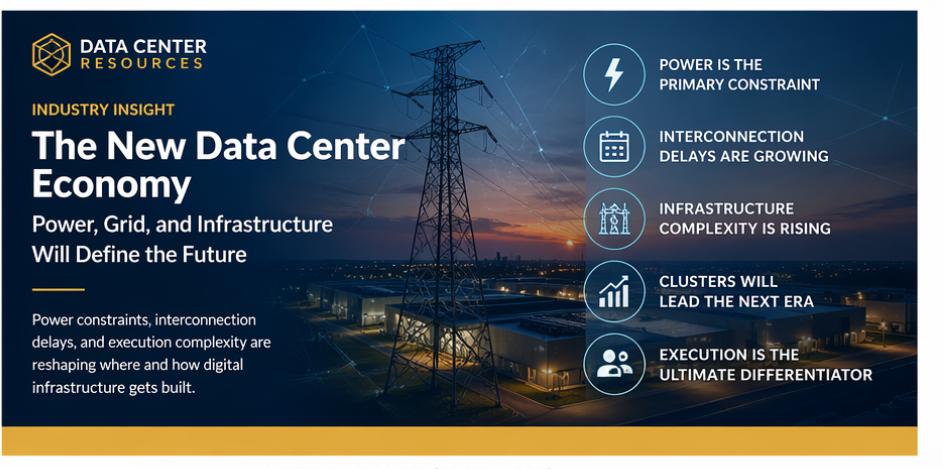
Why infrastructure latency—not just land, power or capital—is becoming one of the most important risks in data center development
By Megawatt Path | Infrastructure Insights | September 2026
The data center industry is entering a new phase of growth in which demand is moving faster than the physical infrastructure required to support it.
For years, development strategy focused heavily on land availability, fiber connectivity, tax incentives, construction costs and access to major markets. Those factors still matter. But the defining challenge has shifted upstream.
A project may have secured land.
It may have a credible customer.
It may have access to capital.
It may even sit near transmission infrastructure.
And it can still lose years to the time required to convert those advantages into usable capacity.
That delay is what we call infrastructure latency.
Infrastructure latency is the gap between when demand exists and when the physical systems required to serve that demand can actually be delivered.
It can appear in the grid.
It can appear in interconnection.
It can appear in substations.
It can appear in fiber.
It can appear in cooling.
It can appear in equipment procurement.
It can appear in permitting.
It can appear in construction.
And increasingly, it is becoming one of the most important risks in large-scale data center development.
The market is very good at pricing land.
It is very good at pricing debt and equity.
It is very good at pricing equipment.
It is far less comfortable pricing time lost to infrastructure dependencies.
That may be one of the biggest blind spots in the next phase of digital infrastructure development.
Infrastructure Latency Is Becoming a Development Risk
The original version of this article described the structural mismatch between the speed of digital demand growth and the slower pace of grid expansion. That remains true.
But the issue extends beyond electricity.
Consider a hypothetical project with the following profile:
the site is controlled,
zoning is favorable,
fiber is within reach,
customer demand is credible,
capital is available,
and the target first-phase load is defined.
On paper, the project appears advanced.
But deeper diligence reveals that the substation requires expansion, transformers have long procurement lead times, utility upgrades require additional study, the cooling system is not fully specified, and one required fiber route has not yet been constructed.
The project is not short of demand.
It is not short of capital.
It is short of time-aligned infrastructure.
That distinction matters because time can destroy economics just as effectively as cost.
A project delayed by several years may miss the customer's deployment window, lose its competitive position, face materially higher financing costs or require a complete redesign.
Infrastructure latency therefore deserves to be treated as a real underwriting variable.
The Market Still Tends to Price Visible Costs Better Than Invisible Delays
Real estate models tend to capture visible costs relatively well.
Land price.
Site work.
Construction.
Equipment.
Financing.
Taxes.
Professional fees.
Those items can be modeled.
Infrastructure delay is more difficult.
What is the economic cost of a 24-month substation delay?
What is the value lost when an interconnection study slips?
What happens when a transformer order misses a manufacturing window?
What is the opportunity cost of waiting for fiber extension while competing projects reach market first?
What does an additional year of carrying costs do to returns?
These are harder questions because the cost is not always represented by a single invoice.
The damage can show up as:
delayed revenue,
increased interest expense,
customer attrition,
equipment repricing,
redesign,
extended land carrying costs,
lost market opportunity,
or capital trapped in a project that cannot advance.
This is why infrastructure latency can be easy to underestimate.
The market sees the cost of the transformer.
It may not fully price the cost of waiting for it.
Power Remains the Most Visible Source of Latency
Power is still the clearest example.
Electrical infrastructure operates on planning and construction cycles that are fundamentally different from software and computing demand.
A data center customer may want capacity in 24 months.
A utility may require multiple years to complete the transmission, substation or distribution infrastructure needed to serve it.
That gap creates an immediate commercial problem.
The developer is no longer simply asking:
Can this site eventually support 200 MW?
The more important question becomes:
How much capacity can be delivered, in what phases, and by what dates?
The difference between those two questions is enormous.
The first is a theoretical capacity question.
The second is a development schedule.
The original article correctly identified utility readiness and interconnection as major determinants of project timelines.
The new Megawatt Path framework takes that further:
power capacity without timing certainty is incomplete information.
Interconnection Is Where Many Projects Discover the Real Schedule
A property can look attractive long before anyone fully understands the electrical work required to serve it.
That is why interconnection and large-load studies can fundamentally change a project's outlook.
Engineering analysis may identify transmission upgrades.
Substation expansion may be required.
New switching infrastructure may be needed.
Protection systems may need modification.
A new line may need to be constructed.
The site may technically be capable of receiving the requested power.
But the infrastructure path may take far longer than the commercial plan assumed.
That is infrastructure latency in its purest form.
Nothing is necessarily “wrong” with the project.
The physical system simply operates on a different timeline.
The Grid Was Not Built for This Pace of Load Growth
Much of today's transmission and distribution infrastructure was not designed around the speed and concentration of modern digital demand.
Large AI campuses can represent highly concentrated loads.
At sufficient scale, they can require infrastructure historically associated with major industrial development.
That means utilities and transmission systems have to respond to demand patterns they may not have anticipated years earlier when long-range infrastructure plans were created.
At the same time, the grid is also absorbing other sources of load growth.
Industrial electrification.
Manufacturing expansion.
Transportation electrification.
Population growth.
New residential demand.
The data center industry is therefore not competing for capacity in isolation.
It is entering a larger infrastructure allocation problem.
This can make conventional “available power” language dangerously simplistic.
Substations Can Become the Project Clock
The original article correctly emphasized the importance of substations as the interface between high-voltage infrastructure and usable power.
For many projects, the substation can become a practical clock.
The question may not be whether the grid can theoretically support the load.
The question may be how quickly the required transformation infrastructure can be engineered, permitted, equipped and constructed.
That can involve:
site acquisition,
utility engineering,
transformers,
switchgear,
protection systems,
civil work,
permitting,
construction labor,
testing,
and commissioning.
Each carries its own schedule.
The substation therefore becomes more than an electrical asset.
It becomes a development milestone.
Transmission Creates a Different Kind of Latency
Transmission projects operate on even longer horizons.
New high-voltage infrastructure can involve route selection, environmental review, rights-of-way, regulatory approvals, engineering and large-scale construction.
These processes can extend well beyond the normal expectations of commercial real estate development.
This is one reason that markets with existing transmission strength can hold such strategic value.
Developers are not only evaluating capacity.
They are evaluating the amount of infrastructure that already exists between generation and the site.
The fewer major systems that have to be created from scratch, the more credible the schedule can become.
Permitting Latency Can Be Just as Important as Grid Latency
Infrastructure latency does not end with the utility.
A project can have a viable electrical pathway and still face substantial delay through entitlement and permitting.
Data centers may involve zoning approvals, environmental reviews, water considerations, noise restrictions, emissions requirements, traffic planning, building permits and community engagement.
The complexity varies dramatically by jurisdiction.
Some communities actively support large-scale infrastructure development.
Others may impose extensive review.
Neither approach is inherently wrong.
The development implication is that permitting time should be evaluated as an infrastructure variable.
A technically feasible project with a five-year entitlement path may not satisfy a customer requiring near-term capacity.
This is why geography matters beyond power.
Cooling Can Create Latency Before Construction Starts
Higher-density AI infrastructure is making cooling strategy increasingly consequential.
A project's thermal design can influence water demand, mechanical infrastructure, power requirements, building configuration and equipment selection.
If those assumptions are not resolved early enough, downstream systems may have to be redesigned.
That redesign costs time.
A change in rack density may alter cooling requirements.
Cooling changes may alter electrical demand.
Electrical demand changes may affect equipment sizing.
Equipment changes may affect procurement.
Suddenly, a technical decision inside the white space has propagated backward into the development schedule.
This is another form of infrastructure latency.
The delay is not caused by a single bottleneck.
It is caused by dependencies.
Procurement Latency Is Becoming Part of Development Feasibility
One of the biggest changes in data center development is that procurement can no longer always wait until late in the process.
Some categories of critical infrastructure can have meaningful lead times.
Transformers.
Switchgear.
Generators.
UPS systems.
Cooling equipment.
Controls.
Specialized electrical systems.
The exact timeline varies by market and specification, but the development lesson is consistent:
equipment availability can influence when a project can become operational.
That means procurement planning should increasingly inform development planning.
The question is not simply:
What equipment do we need?
It is:
When must we secure it to protect the energization date?
Capital Has a Time Cost Too
Infrastructure delays also interact directly with financing.
Every month that a project waits can carry economic consequences.
Debt accrues.
Equity remains committed.
Land carrying costs continue.
Engineering teams remain engaged.
Utility deposits may already be outstanding.
Equipment prices may change.
Customer requirements can shift.
This can materially change project returns.
A 12-month delay is therefore not merely a scheduling issue.
It can be a capital event.
That is why infrastructure latency deserves to be considered during underwriting.
A project with a higher initial cost but a more certain development schedule may ultimately be more attractive than a cheaper project with years of unresolved infrastructure risk.
Speed-to-Power Is Really Speed-to-Infrastructure
The industry frequently uses the phrase speed-to-power.
It is useful, but increasingly incomplete.
Power is often the first and most important constraint.
But the actual commercial objective is not power for its own sake.
It is operational data center capacity.
That requires more.
Power.
Interconnection.
Fiber.
Cooling.
Critical equipment.
Construction.
Commissioning.
The broader metric is therefore:
Speed-to-Infrastructure
How quickly can the entire system required for the first usable phase be assembled?
That is closer to the question customers actually care about.
Development Should Be Evaluated by the Critical Path, Not the Checklist
Traditional diligence often resembles a checklist.
Land: yes.
Zoning: yes.
Power: yes.
Fiber: yes.
Water: yes.
Capital: yes.
That format can hide the most important information.
A project can receive a “yes” in every category and still fail its required timeline.
The better approach is to identify the critical path.
What activity takes the longest?
What milestone depends on another milestone?
What resource has the longest lead time?
What cannot begin until a prior study is complete?
What threatens the target energization date?
This shifts development analysis from:
Do we have the pieces?
to:
Can the pieces arrive in the correct sequence?
That is a much more useful question.
AI Is Making Infrastructure Latency More Expensive
AI demand intensifies this issue because the commercial value of near-term capacity can be extremely high.
When demand is strong, missing a market window can carry a larger opportunity cost.
Customers may move to another region.
Another developer may capture the requirement.
Equipment assumptions may change.
Technology may evolve.
Capital markets may shift.
This creates pressure to compress development schedules at the same time physical infrastructure remains slow to expand.
That tension is likely to define a meaningful portion of the next phase of data center growth.
Infrastructure Clusters Can Reduce Some Forms of Latency
The original article discussed the rise of data center clusters and larger infrastructure zones.
That concept becomes even more interesting through the lens of latency.
A mature infrastructure cluster may already possess:
transmission capacity,
utility experience,
fiber routes,
trained contractors,
equipment suppliers,
established permitting processes,
and local familiarity with data center development.
That ecosystem can reduce friction.
Developers do not have to create every capability from scratch.
This is one reason mature markets can remain attractive despite higher land costs.
The infrastructure ecosystem itself has value.
Emerging Markets Can Compete by Reducing Latency
The reverse is also true.
Emerging markets do not need to replicate every advantage of an established market immediately.
They can compete by making infrastructure easier to deliver.
A region with available land, strong transmission, supportive utilities, clear permitting, fiber expansion capability and sufficient construction capacity may create a compelling alternative.
The competitive advantage becomes:
How quickly can this market convert demand into operational capacity?
This reframes economic development.
The winning region may not be the one with the cheapest land.
It may be the one with the shortest credible path to energization.
“Shovel Ready” Should Include Time-to-Infrastructure
The industry frequently uses the phrase shovel ready.
But a site can be entitled and graded while still facing years of infrastructure delay.
That makes the phrase incomplete for data center development.
A more useful readiness assessment should include:
land control,
entitlement status,
power study status,
interconnection milestones,
fiber availability,
cooling feasibility,
critical-equipment requirements,
utility infrastructure schedule,
and realistic first-phase energization timing.
A data center site is not truly advanced because construction equipment can enter the property.
It is advanced when the infrastructure path is increasingly documented.
The Bottleneck Is Often Coordination
There is another form of latency that receives less attention.
Organizational latency.
Different parties hold different pieces of the project.
The utility has one schedule.
The engineer has another.
The supplier has another.
The fiber carrier has another.
The construction team has another.
The capital provider has another.
The customer has another.
When those timelines are not coordinated, delay compounds.
A utility milestone slips and the equipment order moves.
The equipment order moves and the construction sequence changes.
The construction sequence changes and the financing draw schedule changes.
This is why coordination increasingly matters.
The project can only move as quickly as its most important dependency.
The Market Needs a Better Way to Price Infrastructure Latency
The next evolution in data center underwriting should be to treat infrastructure latency as an explicit risk category.
That does not mean assigning one simple number to every delay.
It means recognizing time as an economic input.
A sophisticated project review should ask:
What is the current target energization date?
Which dependencies control it?
How confident are those dates?
What infrastructure is already committed?
What remains conceptual?
What has been studied?
What must still be procured?
What could add one year?
What could add three?
What does each delay scenario do to the project's economics?
This is how infrastructure timing becomes part of capital discipline.
Capacity + Certainty + Time
Megawatt Path increasingly views infrastructure through three variables:
Capacity
How much infrastructure can the site or market ultimately support?
Certainty
How much of that infrastructure is documented, studied, committed or under construction?
Time
When can it actually be delivered?
Any one of these in isolation can be misleading.
Large capacity with no certainty is speculation.
Certainty around a small amount of capacity may limit scale.
Capacity and certainty delivered too late may miss the commercial window.
The strongest infrastructure opportunities increasingly align all three.
Capacity + Certainty + Time.
From Infrastructure Latency to Infrastructure Strategy
The practical response is not to assume every project must have all answers before development begins.
That would be unrealistic.
The response is to identify the long-duration constraints early enough to manage them.
At Megawatt Path, we view that through the broader project pathway:
Site → Power & Energy → Interconnection → Connectivity → Infrastructure → Procurement → Capital & Delivery → Energization
Each stage has potential latency.
Each stage can affect the next.
The objective is to find the critical path early, identify what remains uncertain and connect the project with the specialists, suppliers and infrastructure resources required to reduce that uncertainty.
That is how development becomes more executable.
The Bottleneck No One Wants to Price In
The data center industry has spent enormous time discussing the shortage of power.
That discussion is justified.
But the deeper issue is the time required to assemble the entire infrastructure system.
Land can be acquired quickly.
Capital can sometimes be raised quickly.
Customer demand can appear quickly.
Physical infrastructure usually cannot.
That difference is creating a new category of development risk.
Infrastructure latency.
The projects that outperform may not always be the ones with the cheapest land, the largest claimed power number or the most aggressive schedule.
They may be the ones that best understand their dependencies.
The ones that know what is documented.
The ones that know what must still be built.
The ones that secure long-lead resources early.
The ones that align capital with infrastructure milestones.
And the ones that create the most credible path from opportunity to energization.
Because in the next phase of data center development, the most expensive bottleneck may not be the infrastructure itself.
It may be waiting for it.
Building or Evaluating a Data Center Project?
If you are evaluating a site, working through power and interconnection, sourcing infrastructure, assessing procurement risk or trying to understand the realistic path to energization, Megawatt Path connects the resources and specialists required to move the opportunity forward.
Discuss Your Project →
Megawatt Path
Data Center Infrastructure & Development
From Site to Energization.
