
Why Fast Data Center Projects Make Regulators Nervous
Why Fast Data Center Projects Make Regulators Nervous
The meeting is supposed to be routine.
The site is controlled. The capital is committed. The power studies are complete. The developer walks in expecting momentum and walks out with silence no follow-up questions, additional review cycles, and no clear timeline.
Nothing is wrong with the project. That is precisely the problem.
In today’s data center economy, speed is treated as proof of competence. Faster permitting, faster power delivery, faster construction velocity has become shorthand for quality. But inside regulatory offices, speed tells a different story. It raises questions. It introduces exposure. And increasingly, it triggers a quiet resistance that developers misinterpret as bureaucracy, when it is actually risk management.
The paradox is simple: the faster a data center project tries to move, the more likely it is to slow itself down.
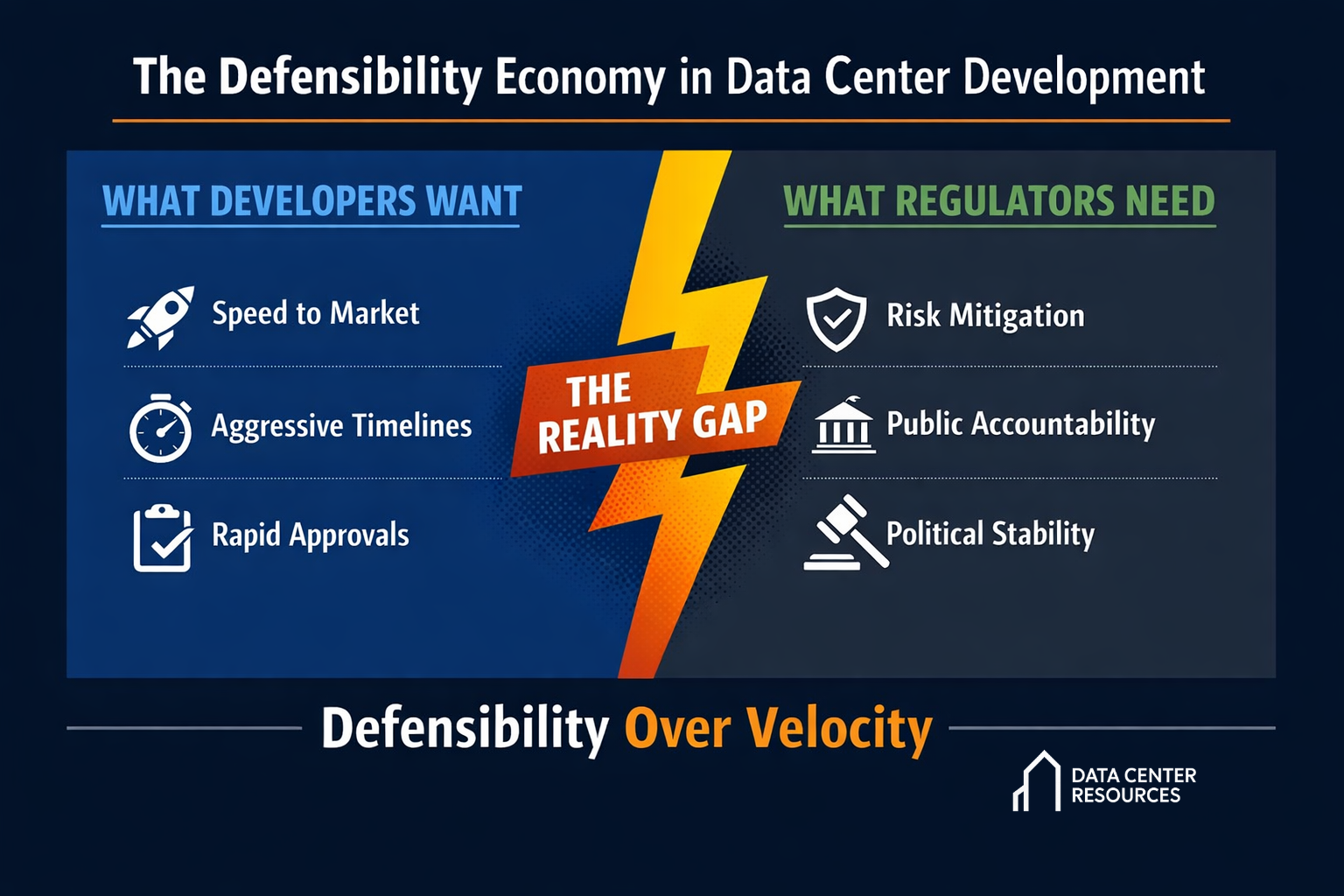
This is not because regulators oppose development. It is because they operate inside what can best be described as the defensibility economy—a system where the primary objective is not speed or growth, but the ability to justify decisions long after they are made.
The Defensibility Economy
In private markets, speed signals preparedness. Capital that moves quickly is presumed to be sophisticated. Teams that compress timelines are assumed to be experienced. Delay is read as weakness.
In government, the logic reverses.
Speed suggests asymmetry. It implies that decisions are being requested before uncertainty is fully mapped, before political and community exposure is understood, and before downstream consequences can be safely absorbed. A fast-moving project does not look impressive inside an agency—it looks like a potential future headline.
Regulators do not optimize for velocity. They optimize for defensibility.
Defensibility means decisions that can withstand audits, elections, lawsuits, media attention, and public backlash. It favors precedent over novelty, documentation over intuition, and process over acceleration. Time is not inefficiency in this system. It is insulation.
Speed compresses that insulation.
Regulators Are Incentivized to Avoid Visible Failure
There is a persistent myth in the industry that regulators are rewarded for approving strong projects quickly. In reality, they are rewarded for avoiding approvals that age poorly.
A regulator who delays a project rarely faces consequences. A regulator who approves a project that later destabilizes a grid, triggers community opposition, or becomes politically controversial does. Career advancement in the public sector is built on caution, not velocity.
From this vantage point, additional studies, extended comment periods, and layered approvals are not signs of dysfunction. They are rational responses to asymmetric risk.
Speed collapses that buffer. And collapsed buffers make people nervous.
AI Changed the Stakes
Traditional data centers were familiar infrastructure. Their power demands were large but predictable. Their economic impact was incremental. Their failures were local.
AI-scale data centers are something else entirely.
They concentrate unprecedented load into single sites. They challenge long-standing grid planning assumptions. They attract national attention. And they increasingly sit at the intersection of energy policy, industrial strategy, and public accountability.
For regulators, approving an AI data center is no longer a technical decision. It is a systemic one.
When these projects move quickly, the perceived downside grows. The question shifts from whether a project is compliant to whether it will become the precedent everyone regrets.
The Career Risk of Saying Yes
Every major approval has a human name attached to it.
Planning directors sign letters. Commissioners cast votes. Utility regulators approve interconnections. Environmental officials certify findings.
If a project performs as promised, the outcome is quiet. If it fails—through outages, rate impacts, water controversy, or political backlash—the record is permanent. Delay, by contrast, is almost never punished.
The result is predictable. When speed forces officials toward irreversible decisions, the instinctive response is to slow the clock.
Utilities Fear Precedent More Than Load
Utilities are often portrayed as capacity-constrained obstacles to AI expansion. The reality is more structural.
When a utility regulator approves a fast, large-load interconnection, they are not approving one project. They are rewriting the future queue.
Every subsequent developer will point to that approval as precedent. Every rate case will reference it. Every grid disruption will trace back to it. If the first fast approval produces instability or public backlash, the institutional cost is immense.
Slowing down is not obstruction. It is precedent management.
From the utility perspective, speed without structural adaptation is destabilizing—and destabilization is the one outcome regulators are explicitly tasked with preventing.
Speed and the Social Contract
Development operates under an unspoken agreement: growth is allowed in exchange for predictability, transparency, and public benefit.
Fast-moving data center projects often appear to bypass this exchange. Communities interpret speed as exclusion. Local officials interpret it as political exposure. Regulators interpret it as fragility.
When the process feels rushed, resistance becomes rational.
Why Perfection Raises Suspicion
Developers frequently assume that immaculate applications accelerate approval. In practice, they can have the opposite effect.
Exceptionally polished submissions raise uncomfortable questions. Why is everything resolved so early? Which risks are being abstracted away? Who was consulted—and who was not?
In a system where most projects are messy, perfection stands out. And regulators are trained to interrogate anomalies.
Speed itself becomes the anomaly.
Process as Armor
What developers experience as bureaucracy, regulators experience as protection.
Process distributes accountability. It creates records. It turns individual judgment into institutional consensus. When a project attempts to bypass or compress that process, it removes the armor regulators rely on to survive scrutiny.
The response is predictable: more steps, not fewer.
When Speed Actually Works
There are exceptions.
Some projects do move quickly. But they share common traits. Regulators feel ownership rather than pressure. Risk is shared rather than shifted. Flexibility is designed into approvals instead of demanded after the fact.
These projects do not feel fast. They feel safe.
The Strategic Reframe
The most effective developers no longer ask how fast they can go.
They ask how safe their project feels to approve.
That shift—from velocity to defensibility—changes everything.
Final Thought
Speed is not the enemy of data center development.
Misunderstood speed is.
In the AI era, the winners will not be the loudest or the fastest. They will be the teams that understand the defensibility economy well enough to move quickly without making others feel exposed.
That is not an engineering skill.
It is a strategic one.
