
Why Most Data Center Projects Fail Before Construction Begins
The data center industry did not slow down.
It clarified.
Demand remains strong. Capital is still available. Hyperscalers, enterprises, and infrastructure investors continue to compete for viable sites. Yet an increasing number of projects are stalling—or quietly dying—long before a shovel hits the ground.
Not because the market changed.
Because assumptions did.
In 2026, the risk profile of data center development is being rewritten. The projects that fail today don’t fail spectacularly. They fail early, invisibly, and expensively—during site selection, interconnection planning, and infrastructure sequencing.
This article breaks down why data center projects fail before construction begins, what decision-makers still misunderstand, and how serious developers are adjusting their approach.
The Myth of the “Later Fix”
For years, data center development followed a familiar playbook:
Secure land.
Confirm zoning.
Line up capital.
Solve infrastructure along the way.
That sequence no longer works.
The most common failure pattern we see is the belief that foundational infrastructure issues—especially power—can be addressed after land is acquired and capital is committed.
They can’t.
Power interconnection, utility upgrades, transmission access, and permitting are not parallel tasks. They are gating items. When misjudged, they freeze projects indefinitely while costs continue to accrue.
The idea of “we’ll figure it out later” has become the most expensive sentence in data center development.
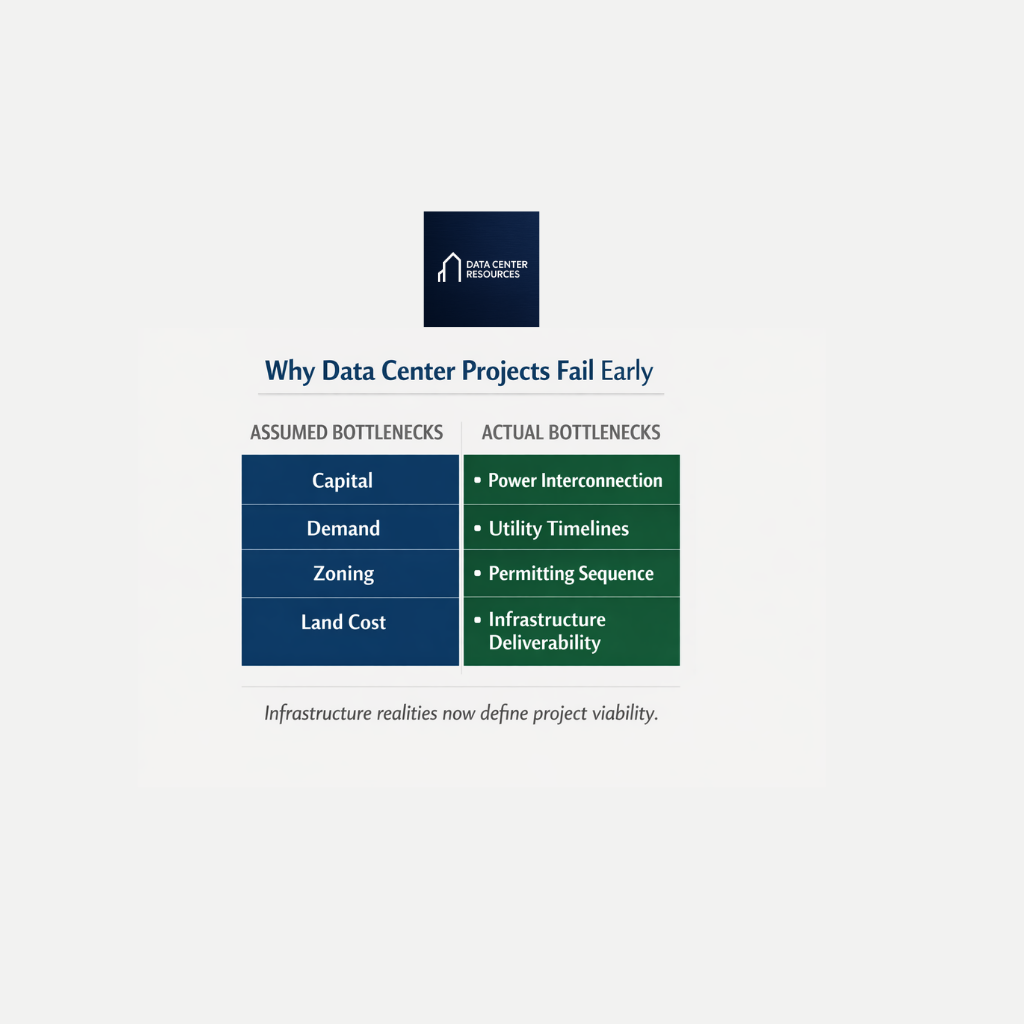
Assumed Bottlenecks vs. Real Bottlenecks
A growing disconnect exists between what stakeholders think limits projects and what actually does.
Commonly Assumed Bottlenecks
Capital availability
Market demand
Zoning approvals
Land acquisition cost
Actual Bottlenecks
Power interconnection timelines
Utility capacity constraints
Permitting sequence and dependencies
Infrastructure deliverability, not entitlement
The difference matters.
Many sites look viable on paper—zoned correctly, priced competitively, and located in growth markets. But viability today is not about entitlement. It’s about execution.
Power Is Not Just Capacity—It’s Timing
The industry has learned to talk about megawatts. It has not fully adapted to talking about time.
A site with theoretical power capacity but a seven-year interconnection timeline is not viable for most projects. Yet these sites continue to trade hands, supported by outdated assumptions that timelines will compress or exceptions will be made.
Utilities are not flexible the way developers expect them to be. Interconnection queues are long, engineering studies are slow, and upgrades often require coordination across multiple agencies.
In practice, this means:
A site with “available power” may not receive it within an investable timeframe
Utility letters of intent are not guarantees
Transmission upgrades can reset timelines entirely
Power is no longer just a technical requirement. It is the single most important scheduling risk.
Zoning Is Not the Same as Build-Ready
Zoning remains one of the most misunderstood elements of site selection.
Being zoned for industrial or data center use does not mean:
Permits will be issued quickly
Environmental reviews will be minimal
Local stakeholders will support the project
Infrastructure sequencing is aligned
Many projects stall after zoning because permitting dependencies were not mapped in advance. Wetlands, right-of-way access, road improvements, substations, and environmental mitigation can all introduce delays that were never reflected in initial pro formas.
In 2026, zoning is table stakes—not a differentiator.
The Cost of Early-Stage Failure
When a project fails late, it’s obvious.
When it fails early, it’s often misdiagnosed.
Early-stage failure shows up as:
Capital tied up in non-performing land
Repeated feasibility revisions
“Temporary” holds that become permanent
Quiet partner exits
Strategic drift
These failures rarely make headlines, but they erode returns and credibility. They also create a false narrative that the market is slowing, when in reality the bar for deliverability has risen.
Infrastructure Deliverability Is the New Valuation Metric
Land price used to be a primary driver of site competitiveness. Today, deliverability outweighs cost.
A more expensive site with a clear, realistic infrastructure path will outperform a cheaper site with unresolved dependencies every time.
Sophisticated developers now ask different questions:
When—not if—can power be delivered?
What upstream upgrades are required, and who controls them?
Which permits are sequential, not parallel?
What political or utility alignment already exists?
These questions determine whether a site is investable or speculative.
Why Some Projects Still Succeed
Despite tightening constraints, projects are moving forward. The difference is not luck—it’s discipline.
Successful projects share common traits:
Infrastructure analysis precedes land acquisition
Utility engagement happens early and continuously
Timelines are stress-tested, not optimistic
Permitting is sequenced, not assumed
Capital is aligned with realistic delivery schedules
These developers treat infrastructure as the foundation, not a line item.
The 2026–2028 Outlook: Fewer Sites, Higher Conviction
Looking ahead, the industry is not running out of demand—it’s running out of mispriced optimism.
Expect:
Fewer speculative land plays
Higher premiums for proven infrastructure paths
Earlier utility involvement in site selection
Increased scrutiny from capital partners
This shift favors operators and advisors who understand the realities of power, permitting, and sequencing—not just market demand.
A Final Word on Risk
The biggest risk in data center development today is not external.
It’s internal—embedded in assumptions that no longer hold.
Projects don’t fail because the market turns.
They fail because infrastructure realities were ignored until it was too late.
About Data Center Resources
Data Center Resources works upstream of failure—helping developers, investors, and partners evaluate land, power, and infrastructure realities before capital is committed.
In a market where deliverability defines value, early clarity is the most valuable resource of all.
