
A Data Center Project Needs More Than Land and Power
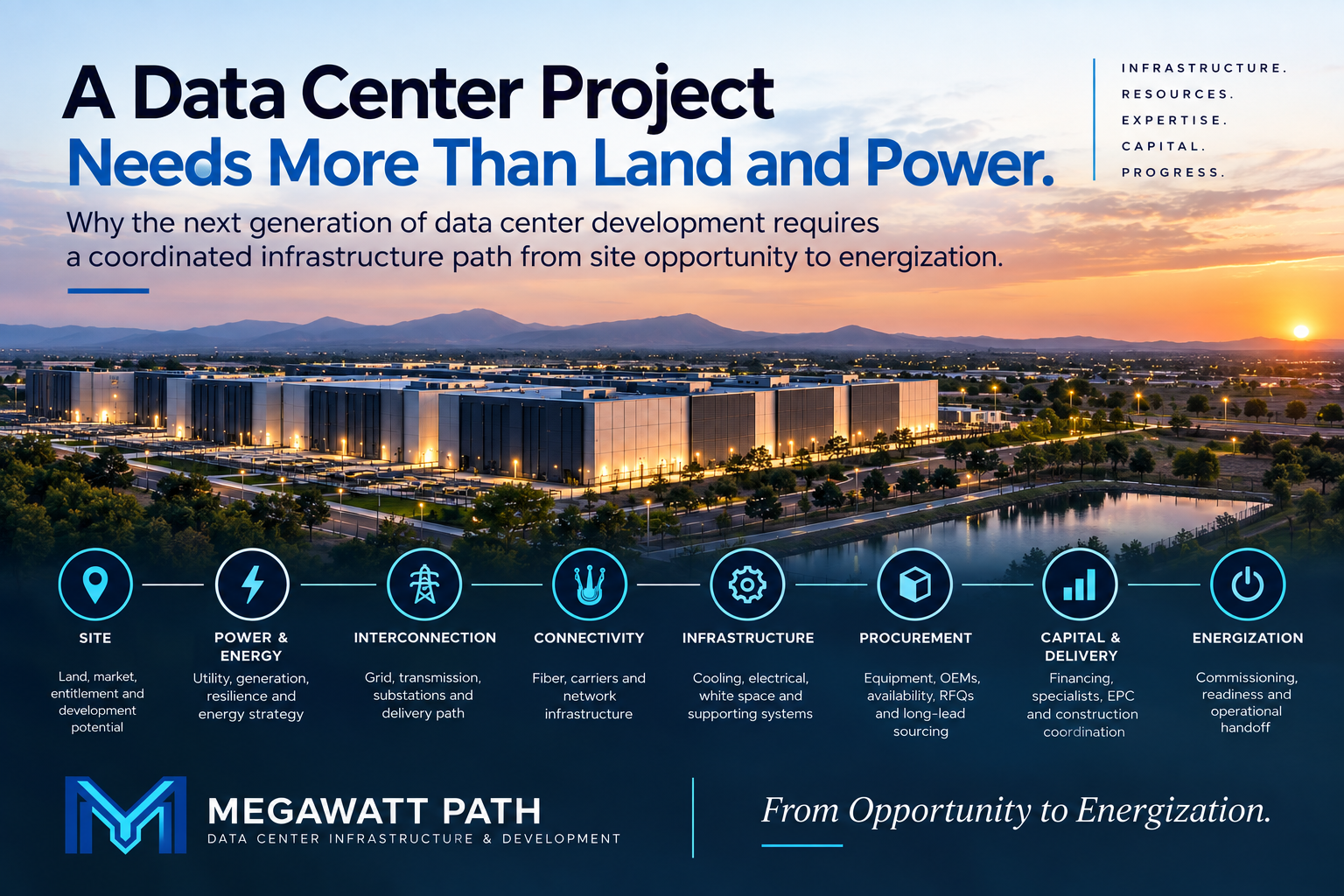
Why the next generation of data center development requires a coordinated infrastructure path from site opportunity to energization
For years, two questions have dominated early conversations around data center development: Where is the land, and where is the power?
Both questions are essential. Neither is sufficient.
A large parcel near transmission infrastructure may look compelling on a map but still face years of work before it can support an energized data center. A property may sit close to a substation without having confirmed capacity available to serve the proposed load. A market may offer attractive land economics but lack the fiber diversity, utility infrastructure, water resources, equipment availability or development conditions necessary to support the project on its required timeline.
Even when the land and power strategy are credible, the project is still far from complete. Modern data center development requires an interconnected system of land, energy, grid infrastructure, utility coordination, fiber connectivity, cooling, electrical systems, critical equipment, engineering, capital, construction, commissioning and project delivery.
Each has its own constraints. Each has its own timeline. Each involves different counterparties. Increasingly, decisions made in one part of the project affect what is possible everywhere else.
That is why the central challenge in data center development is becoming larger than simply finding acreage or identifying megawatts.
The challenge is creating a credible infrastructure path from opportunity to energization.
Acreage Is Not Infrastructure
The growth of artificial intelligence, cloud computing and digital services has intensified interest in properties that could potentially support data center development. It has also created an enormous amount of noise around what actually constitutes a viable data center site.
A property may be marketed as a data center opportunity because it contains hundreds of acres. Another may attract attention because transmission lines cross the property. A third may be described as “powered land” because a substation is nearby. Those characteristics can certainly matter, but none of them independently makes a site data-center ready.
Acreage is one component of a much larger development equation.
A serious site evaluation needs to consider actual developable acreage, zoning and land-use restrictions, environmental conditions, construction and operational access, water and wastewater, fiber connectivity, existing utility infrastructure, transmission and substation context, development requirements and the realistic timeline for bringing those pieces together.
This quickly transforms a real estate conversation into an infrastructure conversation.
A 500-acre parcel with significant infrastructure constraints can ultimately be less attractive for data center development than a smaller property with a credible pathway to power, connectivity and development.
This is why site selection increasingly needs to begin with infrastructure reality rather than acreage alone. The most important question is not simply how much land is available.
It is what can realistically be built there, at what scale, and on what timeline.
Nearby Power Is Not Deliverable Power
Power remains one of the most consequential constraints facing data center development, but the language surrounding power can create false confidence.
A transmission line near a property does not establish that sufficient capacity is available. A nearby substation does not guarantee that the proposed load can be served. A preliminary utility conversation does not necessarily establish an energization date. And a stated megawatt requirement is not the same thing as an energized megawatt.
The distinction matters enormously.
A developer may envision a 100 MW, 300 MW or even larger campus, but the practical question is how that demand interacts with the electrical infrastructure serving the location. That can involve generation resources, transmission capacity, substations, transformers, utility planning, system upgrades, equipment availability, regulatory processes, engineering and construction.
The result is that power cannot simply be treated as another checkbox in site diligence.
Power is part of the development strategy itself.
Developers increasingly need to understand not only how much power they ultimately require, but how that demand might be phased. A campus may ultimately require hundreds of megawatts, while an initial phase could require substantially less. Understanding whether capacity can be delivered incrementally—and what infrastructure must be constructed to support each phase—can materially affect the development strategy.
Energy planning is also becoming broader than the traditional utility conversation. Depending on the project, developers may need to evaluate storage, backup generation, resilience strategies, on-site resources or other energy infrastructure alongside the long-term utility solution.
The industry does not simply need more megawatts.
It needs greater certainty around which megawatts can actually be delivered, when they can be delivered and what infrastructure is required to get them there.
Interconnection Is a Development Workstream
One of the most important distinctions in early-stage data center development is the difference between power in a market and power deliverable to a specific site.
A region may have substantial generation. A transmission corridor may cross the area. A utility may actively support economic development. None of those facts independently determines whether a particular project can receive its requested load on its desired schedule.
The path between theoretical capacity and usable capacity can involve significant infrastructure. Transmission improvements may be required. New substations or substation expansions may be necessary. Transformers, switchgear and other electrical equipment may need to be procured. Utility studies, engineering, permitting and construction may all influence the eventual timeline.
That is why interconnection should be considered much earlier in the development process.
Developers, investors and landowners need to distinguish between what is physically nearby and what can realistically be delivered to the site. That distinction can affect land value, project value, capital decisions, procurement strategy and ultimately the credibility of the development schedule.
Connectivity Is Infrastructure Too
Power understandably receives enormous attention in the current data center market. But data centers ultimately exist to process, store and move information, making connectivity another fundamental part of the infrastructure equation.
A site can have attractive land economics and a promising energy story while still requiring significant work to establish the network infrastructure needed for a large-scale facility.
Fiber diligence should therefore extend beyond identifying a nearby route. Depending on the project, developers may need to understand carrier availability, route diversity, redundancy, latency considerations, physical entry points, rights-of-way and the construction required to connect the campus.
Like electrical infrastructure, fiber has a physical component. Routes have to reach the property. Redundancy has to be designed. New infrastructure may need to be constructed. Those activities have schedules, costs and dependencies of their own.
The broader lesson is straightforward:
Digital infrastructure still depends on physical infrastructure.
Connectivity belongs in the development conversation from the beginning, not after the land and power questions have already been answered.
Cooling Is Becoming a Strategic Development Decision
The evolution of computing is also changing the physical requirements of data centers. Higher-density workloads, including advanced computing and artificial intelligence applications, are increasing the importance of cooling strategy.
Cooling is not merely an equipment decision. The selected architecture can affect electrical demand, water requirements, mechanical infrastructure, building design, equipment selection, redundancy, capital expenditure and operating costs.
Traditional air-cooling architectures may remain appropriate for many deployments, while higher-density environments may require liquid cooling or hybrid approaches. The appropriate solution depends on the technical requirements of the facility.
That means developers increasingly need to understand the intended computing environment earlier in the process. A facility designed around one density assumption may require substantial changes if the eventual operator's requirements differ.
Cooling therefore belongs in the infrastructure conversation from the beginning because the systems are interdependent. Power affects cooling. Cooling can affect water and electrical requirements. Density affects equipment. Equipment affects procurement. Procurement affects schedule. Schedule affects capital.
The infrastructure stack cannot be planned effectively as a series of unrelated components.
Critical Equipment Can Determine the Schedule
For many developments, procurement was historically viewed primarily as something that happened after design had advanced significantly.
That assumption is becoming harder to maintain.
A modern data center can require transformers, switchgear, generators, uninterruptible power supplies, battery systems, power distribution equipment, busway, chillers, cooling towers, pumps, controls, racks, containment, network infrastructure, fire and life-safety systems, security systems and many other components.
Availability can vary substantially by equipment type, manufacturer, specification and market conditions. When a critical component has an extended manufacturing or delivery timeline, procurement can become part of the project's critical path.
A project may control the land, have financing and establish a credible energy strategy, but its schedule can still be affected if essential infrastructure cannot arrive when required.
This changes how procurement should be approached.
It does not mean equipment should be ordered before technical requirements are established. It means developers benefit from understanding equipment requirements, potential sourcing constraints and supplier capacity early enough to incorporate procurement risk into the development strategy.
Procurement is increasingly a development issue.
Procurement Should Start With the Project, Not the Catalog
That reality also changes what an infrastructure marketplace should look like.
The data center industry does not need another generic ecommerce store filled with equipment listings. Major infrastructure projects do not begin with someone browsing hundreds of products and deciding what looks useful.
They begin with project requirements.
Where is the project? What capacity is required? What is the first-phase load? What redundancy is expected? What cooling architecture is contemplated? What is the target energization date? Which systems have already been specified? Which remain flexible? Which components could threaten the schedule?
Those questions should drive procurement.
The process becomes:
Project Requirements → Technical Scope → Supplier Identification → Availability → RFQ → Commercial Structure → Procurement → Delivery
The value is therefore not simply listing transformers, generators, cooling equipment or switchgear. The greater opportunity is connecting project requirements with appropriate suppliers, specialists and sourcing pathways.
This is an important distinction for the future of data center infrastructure procurement.
The project should be the starting point—not the product catalog.
Capital Has to Follow Infrastructure Reality
Data centers are capital-intensive assets, which makes financing an integral part of the infrastructure conversation.
But capital cannot solve every infrastructure problem.
A project with unresolved land control, uncertain power, unclear interconnection requirements and unrealistic equipment assumptions does not become executable simply because financing is available.
The strongest projects create increasing levels of certainty as they advance. Land control becomes clearer. Power assumptions become documented. Interconnection requirements become better understood. Development milestones progress. Technical requirements become more defined. Procurement strategy becomes more credible.
The risk profile evolves as those questions are answered.
That progression matters to capital providers.
Different stages may also require different capital solutions. Early development capital can serve a different purpose than construction financing. Equipment financing may be appropriate for certain infrastructure. Strategic capital may participate differently than conventional debt. Larger developments can require multiple layers of capital over their lifecycle.
The financing strategy should therefore evolve alongside the infrastructure strategy.
Capital should be aligned with the stage of the project and the certainty that has actually been created.
No One Company Builds the Entire Infrastructure Stack
Modern data center development requires specialized expertise.
Utilities, electrical engineers, civil engineers, environmental consultants, fiber providers, equipment manufacturers, distributors, EPC firms, contractors, commissioning specialists, capital providers, legal professionals and numerous other organizations may participate in a single development.
No credible organization needs to pretend it performs every one of those functions internally.
The challenge is often connecting the right expertise to the right project at the right stage.
A utility or energy specialist may be critical during early feasibility. Engineering requirements become increasingly important as the technical architecture develops. Fiber providers may need to evaluate connectivity. Environmental professionals may identify site constraints. OEMs and suppliers can help establish equipment availability. Capital partners need to understand development milestones. Construction and commissioning organizations become increasingly important as execution advances.
These relationships are not interchangeable.
The right capability introduced at the appropriate stage can remove a major project constraint. The same capability introduced too late may create schedule problems that could have been avoided.
That makes coordination itself a source of value.
The Data Center Is Becoming Infrastructure
There is a larger shift underneath these individual issues.
The data center is increasingly being understood not simply as a building containing servers, but as a major infrastructure system.
At sufficient scale, a data center campus interacts with energy systems, transmission networks, water resources, telecommunications infrastructure, transportation, construction supply chains, capital markets and regional development.
The largest projects can resemble infrastructure programs as much as conventional real estate developments.
Traditional real estate questions remain important. Where is the site? What is the zoning? What can be built? What does the land cost?
But increasingly, those questions have to be joined by a much larger set of infrastructure questions.
Where will the energy come from? How will it reach the property? What grid improvements are necessary? What does the interconnection path look like? What fiber infrastructure is available? What cooling architecture is appropriate? Which critical systems are required? What must be procured early? Who will engineer and construct the infrastructure? How will the project be financed? What ultimately determines energization?
This is a much broader development framework.
The data center is becoming infrastructure.
The Infrastructure Stack Is Interdependent
Complex projects naturally divide into specialized workstreams: land, power, engineering, procurement, capital, construction and operations.
The problem is not specialization. The problem arises when assumptions made by one workstream do not match the reality of another.
Consider a project targeting a specific energization date. The development schedule assumes utility infrastructure will be completed by then. The utility schedule depends on equipment that has not yet been ordered. The equipment specification depends on engineering that is still underway. Engineering depends on a final load profile. The load profile depends on an operator requirement that changes. Financing was structured around the original construction schedule.
What appeared to be one schedule problem is actually a chain of interconnected dependencies.
That is why coordination matters.
The objective is not to eliminate specialized workstreams. It is to ensure the major dependencies between them are visible early enough to manage them intelligently.
Infrastructure development is a sequence of dependencies.
The more clearly those dependencies are understood, the more intelligently the project can advance.
Time Is an Infrastructure Variable
Data center infrastructure is usually discussed in terms of quantity.
How many acres? How many megawatts? How much fiber? How much capital?
There is another variable that can be equally important:
When?
Two hundred megawatts potentially available seven years from now represents a very different development opportunity from an initial block of capacity available considerably sooner with a credible pathway to expansion.
A transformer with an extended lead time creates a different development schedule from equipment available within the project's procurement window. A fiber route requiring significant construction changes the timeline. A lengthy permitting process changes the capital plan. A site requiring substantial transmission upgrades presents a different opportunity from one where infrastructure can be expanded more quickly.
Time therefore needs to be incorporated into infrastructure evaluation.
The most valuable infrastructure is not always the infrastructure with the greatest theoretical capacity. It may be the infrastructure with the greatest certainty of delivery within the project's required timeframe.
A more useful development equation is:
Capacity + Certainty + Time
All three matter.
“Powered Land” Needs More Precision
As demand for data center sites has increased, so has the use of phrases such as “powered land.”
But the term can represent very different levels of infrastructure certainty.
For one property, it may simply mean electrical infrastructure is physically nearby. For another, a utility may have held preliminary discussions with the landowner. Another project may have completed more substantial analysis or begun an interconnection process.
Those situations are not equivalent.
The industry benefits when infrastructure claims become more precise.
Instead of simply asking whether a property “has power,” stakeholders should ask what documentation exists, which utility is involved, what load has been discussed, what studies have been completed, what infrastructure is required, who would be responsible for delivering it, which assumptions remain unresolved and what schedule has actually been discussed.
Not every early-stage property needs a final utility commitment before it can be evaluated or marketed. But the level of certainty should be represented accurately.
The industry needs fewer claimed megawatts and more documented megawatts.
Site Selection Is Increasingly Following Infrastructure
Historically, site selection could begin primarily with geography and real estate.
Identify a desirable market. Find suitable land. Then evaluate the infrastructure.
For certain large-scale data center developments, that sequence is increasingly changing.
The first question may instead become: Where can the required infrastructure realistically be delivered?
Then: Which sites within that infrastructure environment make sense?
This means following more than cheap land.
It is following electrons.
It is also following fiber, transmission, substations, water where required, generation resources and development certainty.
That shift can change the map of attractive data center markets. Secondary and emerging markets can become compelling when they combine suitable land with credible infrastructure. Conversely, inexpensive acreage can quickly lose its advantage when the infrastructure required to serve it creates years of additional development work.
Cheap land does not compensate for a five-year infrastructure problem.
From Site Selection to Infrastructure Orchestration
All of these changes point toward a broader role in data center development.
The opportunity is larger than brokerage. Larger than equipment sales. Larger than power consulting. Larger than financing. Larger than development advisory.
Projects increasingly need infrastructure orchestration.
That means connecting the relevant resources around a common project and understanding how each workstream affects the next.
At Megawatt Path, we view that infrastructure path through eight connected stages:
1. Site
Land, market conditions, entitlement, environmental considerations, access and development potential establish the foundation.
2. Power & Energy
Utility infrastructure, generation, storage, resilience, load requirements and energy strategy establish how the project can be supported.
3. Interconnection
Transmission, substations, grid constraints and utility processes determine the path toward deliverable capacity.
4. Connectivity
Fiber, carriers, route diversity and network infrastructure connect the facility to the digital ecosystem it exists to serve.
5. Critical Infrastructure
Cooling, electrical distribution, backup systems, white-space infrastructure, controls and supporting systems define the physical operating environment.
6. Procurement
Equipment availability, OEM relationships, supplier capacity, RFQs and long-lead sourcing translate requirements into physical infrastructure.
7. Capital & Delivery
Financing, engineering, development, EPC, construction and specialist resources move the project from planning toward execution.
8. Energization
Commissioning, infrastructure completion and operational readiness bring those workstreams together around usable capacity.
The process will rarely be perfectly linear. Several stages may move simultaneously. Some workstreams will advance while others wait. New information may require earlier assumptions to be revisited.
But the framework provides something increasingly valuable:
A common view of the infrastructure path.
The Infrastructure Marketplace Should Start With the Project
This framework also changes what a data center infrastructure marketplace can become.
A conventional marketplace begins with products.
A project-centered marketplace should begin with the project itself.
A developer could define the location, acreage, target capacity, phase-one load, energization objective, redundancy requirements, cooling strategy, utility status, fiber status, development stage, equipment requirements and capital needs.
From there, the objective is not simply to display a catalog.
It is to identify what the project still needs.
That may include transformers, switchgear or cooling equipment. But it could also include engineering, fiber, energy resources, commissioning, construction, development services or capital.
The marketplace becomes less about selling individual items and more about connecting project demand with infrastructure capability.
That is the larger opportunity.
Data Center Development Needs a Common Operating View
The same principle applies to technology.
Data center development produces enormous amounts of fragmented information: site documents, utility correspondence, engineering studies, equipment quotations, environmental reports, fiber information, construction schedules, capital discussions and partner communications.
Much of that information exists in separate systems, spreadsheets and inboxes.
A common operating view can organize the project around the questions that actually determine progress.
What has been verified? What remains an assumption? What is blocking the next stage? Which equipment presents schedule risk? Which partner owns the next action? Which milestones affect energization? What documentation supports the project's infrastructure claims?
This is where an infrastructure platform can eventually become more than a CRM.
It can become a project intelligence layer connecting site, infrastructure, procurement, partners, capital and execution.
The ultimate value is not the software itself.
The value is better infrastructure decisions.
What This Means for Developers, Landowners, Suppliers and Capital
For developers, the implication is that infrastructure diligence needs to begin earlier. The larger the project and the greater the load, the more expensive incorrect assumptions can become. Development always involves uncertainty, but the objective should be to identify which uncertainties matter most and systematically reduce them.
For landowners, the opportunity is to understand and document what the property actually offers. Acreage alone is not enough. Zoning, utilities, transmission, substations, fiber, water, access, environmental information and existing infrastructure studies can all contribute to a stronger development story. The goal should not be to make a property sound like something it is not, but to establish the strongest defensible case for what it could become.
For manufacturers and infrastructure suppliers, data center growth creates substantial opportunity, but selling into the market requires understanding projects rather than simply products. A supplier that understands schedule, technical architecture, redundancy requirements and delivery constraints can provide substantially more value than one simply quoting equipment.
Capital providers face a similar opportunity. Digital infrastructure requires enormous investment across development capital, equipment financing, construction financing, project finance and strategic investment. Projects with better-documented site, power, interconnection, procurement and development information can provide a clearer basis for evaluating risk.
Across all four groups, the common theme is the same:
Better infrastructure information creates better decisions.
The Next Competitive Advantage Is Coordination
Data center development will continue to require specialists.
Utilities will perform utility work. Engineers will perform engineering. OEMs will manufacture equipment. Contractors will construct facilities. Commissioning teams will commission them. Capital providers will finance projects.
That should not change.
The emerging opportunity is connecting those capabilities more efficiently around real projects.
The industry is scaling quickly. Projects are becoming larger. Infrastructure dependencies are becoming more consequential. Development schedules increasingly depend on organizations that may otherwise operate independently.
That makes coordination increasingly valuable.
In a sense, coordination itself is becoming infrastructure.
Not physical infrastructure, but organizational infrastructure: the information, relationships, systems and workflows that allow physical infrastructure to be evaluated, financed, procured and ultimately delivered.
From Opportunity to Energization
This is the thesis behind Megawatt Path.
We are building around the complete infrastructure path required to advance data center opportunities—not simply land, not simply power, not simply equipment and not simply capital.
Our objective is to connect the infrastructure, resources, expertise and capital required to move projects forward.
Our framework is:
Site → Power & Energy → Interconnection → Connectivity → Infrastructure → Procurement → Capital & Delivery → Energization
And the operating philosophy behind it is equally straightforward:
Source. Coordinate. Procure. Finance. Deliver.
Megawatt Path does not need to replace the engineers, utilities, manufacturers, contractors, capital providers or other specialists that make data center infrastructure possible. The opportunity is to connect those capabilities more effectively around actual projects.
That means helping developers understand what they need. Helping landowners understand what they have. Helping suppliers connect with relevant demand. Helping specialists participate at the appropriate stage. Helping capital understand the infrastructure story. And helping projects move from fragmented assumptions toward increasingly documented, executable pathways.
Because ultimately, the industry's challenge is not simply finding more acreage.
It is not simply identifying more megawatts.
And it is not simply purchasing more equipment.
The challenge is bringing all of those pieces together at the right place, in the right sequence and on a realistic timeline.
A data center project needs more than land and power. It needs an infrastructure path.
And that path has one destination:
Energization.
