
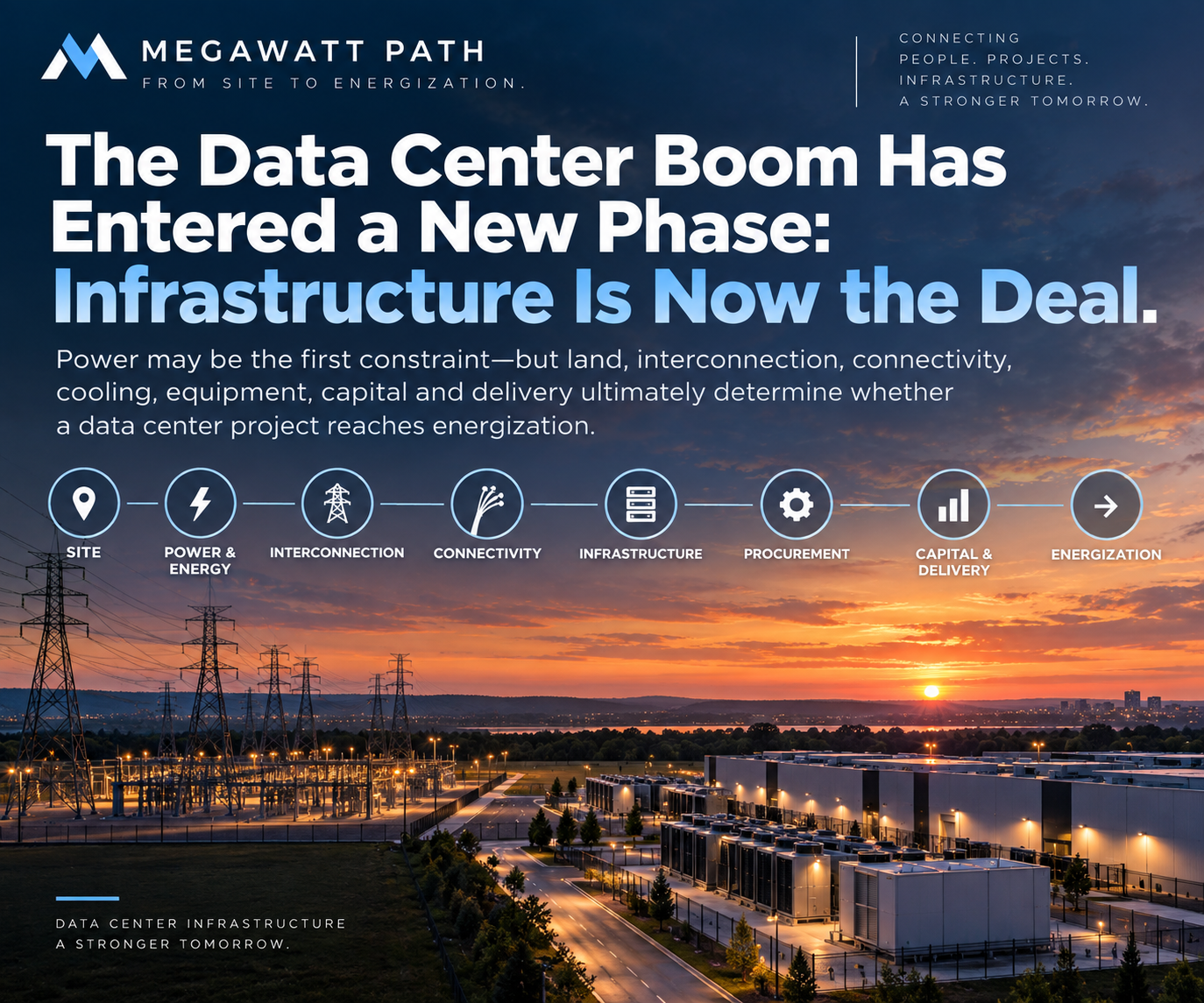
Why power may be the first constraint—but land, interconnection, connectivity, cooling, equipment, capital and delivery ultimately determine whether a data center project reaches energization.
Megawatt Path | Infrastructure Insights | September 2026
For much of the modern data center industry's history, development followed a relatively recognizable formula.
Find land in the right market. Confirm fiber. Establish utility service. Navigate zoning and permitting. Build the facility. Lease or operate the capacity.
That formula is being rewritten.
The defining question surrounding many of today's largest data center developments is no longer simply whether a property has sufficient acreage, favorable zoning, fiber connectivity or proximity to a major population center.
Power has moved to the center of the conversation. Developers increasingly need to know where the electricity will come from, how much can actually be delivered, when it can be energized, what infrastructure must be built to support it, who will bear those costs and whether the surrounding community will support the development.
But even that description no longer goes far enough.
A credible power strategy does not eliminate the need for interconnection. Interconnection does not eliminate equipment lead times. Available land does not guarantee fiber diversity. Generation does not resolve cooling requirements. Capital cannot make a project operational if critical infrastructure cannot arrive on schedule.
The industry is discovering something larger:
The data center boom has become an infrastructure race.
Power may be the first constraint. Infrastructure coordination is increasingly the deal.
AI Changed the Scale of the Infrastructure Problem
Artificial intelligence did not create the data center industry.
Cloud computing, streaming, enterprise IT, e-commerce, social media and the broader digitization of the economy were already driving enormous growth in computing infrastructure.
AI changed the scale.
The International Energy Agency estimated that data centers consumed approximately 415 terawatt-hours of electricity globally in 2024, roughly 1.5% of worldwide electricity consumption, and projects that global data center electricity demand could more than double by 2030.
At the individual campus level, the numbers are becoming equally significant.
Projects measured in hundreds of megawatts—and proposals contemplating gigawatt-scale requirements—do not resemble ordinary commercial electricity customers.
At sufficient scale, the development can become one of the loads around which future electrical infrastructure itself must be planned.
Higher-density computing also affects much more than the utility bill. It influences electrical distribution, cooling architecture, redundancy, equipment specifications, backup generation, water strategy and the physical design of the campus.
The building and its supporting infrastructure can no longer be considered separately.
That is the fundamental shift.
Power, Certainty and Time
For generations, the real estate maxim was location, location, location.
For the next generation of data center development, another equation is becoming increasingly important:
Power + Certainty + Time
A site may have access to an attractive utility territory. That does not tell a developer how much capacity can actually be delivered.
A transmission line may cross the property. That does not establish that the line can serve a 300 MW campus.
A substation may sit nearby. That does not mean the necessary capacity exists inside it.
And even when additional capacity can eventually be created, the commercially relevant question remains:
When?
This distinction can fundamentally change land value.
Imagine two otherwise comparable properties.
Both contain sufficient acreage. Both have favorable topography. Both have fiber access. Both sit within communities interested in economic development.
One has a documented path toward significant electrical capacity within a commercially viable timeline.
The other requires major transmission upgrades, uncertain interconnection work and years of additional infrastructure development.
On a conventional land map, they may appear similar.
To a sophisticated data center developer, hyperscaler or infrastructure investor, they are fundamentally different assets.
Acreage is not infrastructure.
The value of a data center site increasingly depends not only on what exists on the property today, but on what infrastructure can realistically be delivered to it—and when.
“Power Nearby” Is Not Deliverable Power
One of the most persistent problems in data center site marketing is the gap between theoretical power and deliverable power.
There are multiple layers between electricity existing somewhere within a region and electricity becoming usable capacity inside a data center.
Generation must exist. Transmission must carry it. Substations must transform it. Distribution or dedicated infrastructure must reach the campus. Interconnection and utility studies may need to be completed. Reliability requirements must be addressed. Long-lead electrical equipment must be secured. Upgrades may require financing, permitting and construction.
And somebody has to pay for all of it.
This is why a statement such as “500 MW available” should never be the end of diligence.
It should be the beginning.
What is available today?
What is planned?
What requires upgrades?
What has entered a formal process?
What has a defined delivery schedule?
What is supported by agreements?
What is merely a request?
Those distinctions increasingly determine whether a site represents a real infrastructure opportunity or simply a compelling marketing presentation.
A megawatt request is not the same as an energized megawatt.
The industry needs fewer claimed megawatts and more documented megawatts.
The Grid and the Data Center Are Moving at Different Speeds
Technology can move extraordinarily quickly.
Electrical infrastructure usually cannot.
A company can order computing equipment, develop software and deploy new workloads on timelines that bear little resemblance to the schedules required to construct transmission lines, substations, generation facilities or other major electrical infrastructure.
Transformers, switchgear, turbines and other critical components can also carry significant procurement lead times.
This creates one of the defining tensions of the current market.
Demand can move faster than the infrastructure required to support it.
The result is a race for existing and near-term capacity.
That helps explain why data center developers are examining locations that historically may not have appeared on institutional shortlists. The market is not moving geographically only because developers are searching for cheaper acreage.
It is following electrons.
But the next stage of this evolution will require following more than electrons.
It will require following the entire infrastructure path.
Bring Your Own Power Is Really Bring Your Own Infrastructure
As utility delivery schedules stretch, developers and operators are increasingly evaluating alternative energy architectures.
Natural gas generation, renewable resources, battery energy storage, microgrids, nuclear technologies, co-location with existing generation and other behind-the-meter strategies are becoming part of the data center development conversation.
These approaches can be important.
They are not simple shortcuts.
Moving generation closer to the project introduces additional questions about fuel supply, permitting, emissions, reliability, redundancy, ownership, operations, financing and eventual grid integration.
A temporary or bridge-to-grid strategy must also answer what happens when the permanent utility solution arrives.
Can the architecture transition cleanly?
Can it support later phases?
How does it affect financing?
Who owns and operates the assets?
What approvals are required?
The industry is not eliminating the energy problem by bringing generation to the site.
It is bringing more of the energy infrastructure problem inside the development project.
Interconnection Has Become a Development Workstream
Interconnection was once easy for many outsiders to treat as a utility issue.
That distinction is becoming increasingly difficult to maintain.
For large-load projects, interconnection can affect site selection, schedule, cost, financing and ultimately commercial viability.
A project may require utility studies, transmission analysis, system upgrades, substations, new delivery infrastructure or other improvements before the requested load can be served.
Those processes operate on their own timelines.
And those timelines may not align with the customer's required delivery date.
This means interconnection should not sit at the edge of a data center development plan.
It belongs near the center of it.
The project team needs visibility into what has been requested, what has been studied, what remains unresolved, what infrastructure is required and what milestones must occur before capacity becomes real.
Power strategy without interconnection strategy is incomplete.
Connectivity Still Matters
The rise of power as the dominant development constraint should not be interpreted to mean that fiber has become secondary.
Data centers are digital infrastructure.
Connectivity remains fundamental.
Carrier availability, route diversity, latency requirements, network resilience and the cost and timeline required to extend fiber can all affect a site's viability.
A site can have extraordinary power potential and still face a connectivity problem.
This is particularly important as development expands beyond established Tier I markets.
Mature data center markets often contain dense telecommunications ecosystems built over decades. Emerging markets may possess excellent land and energy resources without the same network depth.
That infrastructure can be developed.
But it must be part of the development plan.
The winning markets will not simply be those with available electricity.
They will be the markets capable of assembling power and digital connectivity together.
Cooling Is Becoming a Strategic Development Decision
Higher-density computing is also changing the thermal equation.
Cooling can no longer be viewed exclusively as a mechanical-system decision made late in facility design.
It can affect water requirements, electrical demand, site planning, equipment selection, community discussions and development economics.
Different cooling architectures create different infrastructure requirements.
A project contemplating large-scale liquid cooling may have a different infrastructure profile than a traditional air-cooled facility.
Climate matters.
Water availability matters.
Energy efficiency matters.
Technology choice matters.
The underlying lesson is the same one appearing throughout the development process:
Infrastructure decisions are interconnected.
Changing one part of the stack can change requirements elsewhere.
Critical Equipment Can Become the Schedule
Even when the land is controlled and the energy strategy is credible, a project still has to become physical infrastructure.
That requires equipment.
Transformers. Switchgear. UPS systems. Generators. Cooling systems. Power-distribution equipment. Controls. Pumps. Chillers. Busway. Networking systems. And the numerous components connecting those systems together.
For major projects, procurement can become a development issue rather than simply a purchasing function.
A project can have land and still wait for equipment.
It can have utility support and still face transformer constraints.
It can have capital and still lack a delivery slot.
It can have an interested customer and still miss the customer's required date.
That changes how procurement should be approached.
The question is no longer simply:
What equipment do we need to buy?
It is:
What infrastructure must be secured, in what sequence, from which qualified suppliers, with what lead times, to protect the project's path to energization?
The Marketplace Should Start With the Project
This shift has implications for the way infrastructure is sourced.
Traditional equipment marketplaces begin with products.
A developer searches for a transformer, generator, UPS system or cooling component.
But a data center development does not begin with a product catalog.
It begins with a project.
Where is the site?
How many acres are available?
What is the target campus capacity?
What is required in phase one?
What is the target energization date?
What utility milestones have been reached?
What redundancy is required?
What cooling architecture is contemplated?
What fiber exists?
What equipment has already been specified?
What capital is available?
Once those questions are understood, the infrastructure requirement becomes much clearer.
The project should be the starting point—not the product catalog.
That is the difference between ecommerce and infrastructure coordination.
Community Acceptance Is Becoming Part of Infrastructure
There is another constraint that cannot be manufactured in a factory or delivered by a utility.
Community support.
Data center developments can bring substantial capital investment and expand local tax bases, but communities are becoming more sophisticated about the infrastructure consequences of large projects.
Residents and policymakers increasingly want to understand electricity consumption, water requirements, transmission infrastructure, backup generation, noise, emissions, land use, tax incentives and the allocation of infrastructure costs.
Those questions should not simply be viewed as obstacles.
They are part of development.
A technically feasible project without a credible entitlement and community strategy can still fail.
Infrastructure is ultimately built somewhere.
And “somewhere” has residents, elected officials, utilities, regulators and competing priorities.
Capital Has to Follow Infrastructure Reality
Large-scale digital infrastructure requires enormous amounts of capital.
But capital alone does not remove physical constraints.
Investors and lenders increasingly need to understand what stage of development a project has actually reached.
Is the land controlled?
Is power documented?
What interconnection milestones have been achieved?
What deposits are required?
Are fiber routes available?
What equipment must be ordered?
What entitlements remain?
What is the construction schedule?
Who is the customer?
When is capacity required?
These are not merely technical questions.
They are underwriting questions.
A project with documented infrastructure milestones represents a fundamentally different risk profile from a project built around assumptions.
As the sector matures, capital should increasingly distinguish between infrastructure possibility and infrastructure certainty.
That is healthy for the market.
“Shovel Ready” Needs a New Definition
The phrase “shovel ready” is common in economic development.
For data centers, it can be dangerously imprecise.
A cleared and entitled parcel without a credible path to power may not be ready.
A property with a transmission line nearby but no defined capacity may not be ready.
A site with utility discussions but unresolved fiber, cooling, equipment or entitlement issues may still face substantial execution risk.
For the next generation of data center projects, readiness should be documented across multiple infrastructure layers.
How much capacity?
From where?
By what date?
Through what infrastructure?
Under what agreement?
At what cost?
What upgrades remain?
What approvals remain?
What equipment must be secured?
What is the expansion path?
A truly advanced site is not one where every question has a favorable answer.
It is one where the critical questions have documented answers.
Not Every Announced Gigawatt Will Become an Energized Gigawatt
The current development pipeline contains enormous numbers.
Not all of them will become operating data centers.
Projects compete for power, equipment, construction resources, customers and capital.
Some announced campuses remain conceptual.
Some power requests will not advance.
Some generation proposals will change.
Some customers will alter their requirements.
Some projects will discover that their timelines no longer work.
This distinction matters.
A request for 1 GW is not the same as a contracted 1 GW load.
A proposed 1 GW campus is not the same as an operating campus.
And a regional generation pipeline is not the same as deliverable capacity at a specific property.
The market should become increasingly sophisticated about those distinctions.
The winning projects will be the ones that progressively turn assumptions into commitments.
The Winners Will Reduce Uncertainty
Scale attracts attention.
Certainty creates value.
Consider the difference between two projects.
One has a large acreage number, a large claimed megawatt figure and an ambitious development presentation.
The other has documented land control, credible power milestones, a defined interconnection path, diverse connectivity, an appropriate cooling strategy, equipment visibility, entitlement progress, realistic construction scheduling, capital alignment and identifiable customer demand.
Those are not equivalent projects.
The second has done something enormously valuable:
It has reduced uncertainty.
That matters to hyperscalers.
It matters to utilities.
It matters to lenders.
It matters to institutional capital.
It matters to suppliers.
It matters to communities.
And ultimately it matters to landowners trying to understand what their property is actually worth.
The Data Center Is Becoming Infrastructure
Perhaps the simplest way to understand the current market is to stop thinking about a large data center as merely a building filled with servers.
At sufficient scale, it becomes an infrastructure ecosystem.
There is computing infrastructure.
Electrical infrastructure.
Telecommunications infrastructure.
Cooling infrastructure.
Potential generation and storage infrastructure.
Water infrastructure.
Road and access infrastructure.
Security infrastructure.
Construction infrastructure.
And a financial, regulatory and contractual architecture connecting all of it.
Once the project is viewed this way, many of the changes occurring across the industry become easier to understand.
Utilities are increasingly central to real estate decisions because power infrastructure can determine the schedule.
Regulators are involved because large-load interconnection can affect broader electrical systems.
Communities are involved because infrastructure impacts are local.
Technology companies are exploring new generation strategies because computing growth is becoming inseparable from energy strategy.
Developers are exploring new geographies because infrastructure availability can create viable markets.
The data center is becoming infrastructure.
And infrastructure requires coordination.
The Next Great Data Center Markets May Be Created
The industry's established markets developed over decades.
Fiber attracted customers. Customers attracted operators. Operators attracted suppliers. Infrastructure attracted more infrastructure.
The next generation of markets may emerge differently.
Some may begin with energy resources, transmission infrastructure, industrial land, available acreage, favorable construction economics and communities seeking investment.
Fiber can expand.
Suppliers can follow.
Capital can arrive.
A digital infrastructure ecosystem can develop around a location that previously would not have appeared on a traditional data center map.
But cheap acreage is not enough.
Cheap land does not compensate for a five-year infrastructure problem.
The strongest emerging markets will be those capable of assembling the entire infrastructure package.
The Real Data Center Race Is an Infrastructure Race
AI is often described as a competition for chips, models, talent and capital.
Increasingly, it is also a competition for physical infrastructure.
The world's most advanced computing hardware creates little value if it cannot be energized.
A billion-dollar building cannot produce computing capacity without the systems necessary to power, cool and connect it.
A gigawatt-scale development plan has limited commercial value if the required infrastructure cannot be delivered within the customer's timeframe.
That is why the bottleneck has moved upstream.
The industry is no longer simply racing to construct data center buildings.
It is racing to assemble the infrastructure ecosystems capable of supporting them.
From Site Opportunity to Energization
This is the environment in which Megawatt Path is being built.
We believe the next generation of data center development requires a more connected approach to infrastructure.
Not simply land.
Not simply power.
Not simply equipment.
And not simply capital.
Projects increasingly require a coordinated path across the entire infrastructure stack:
Site → Power & Energy → Interconnection → Connectivity → Infrastructure → Procurement → Capital & Delivery → Energization
No single company performs every discipline required to build a modern data center campus.
Nor should it.
Utilities, engineers, fiber providers, OEMs, EPC firms, contractors, commissioning specialists, environmental professionals, capital providers and numerous other qualified organizations each play distinct roles.
The opportunity is to connect those resources around the project.
To understand what the project has.
Identify what it still needs.
Coordinate the next decision.
Source the appropriate resources.
And continue reducing uncertainty until an opportunity becomes something that can actually be built.
That is the broader shift taking place across digital infrastructure.
The scarce resource is no longer simply land.
It is not simply megawatts.
It is not simply capital.
It is the ability to bring capacity, certainty and time together across an increasingly complex infrastructure stack.
Coordination itself is becoming infrastructure.
And the next generation of data centers will be built by the organizations capable of connecting the entire path.
Building or Evaluating a Data Center Project?
Whether you are evaluating land, developing an energy strategy, working through interconnection, assessing connectivity, sourcing critical infrastructure, seeking capital or coordinating project delivery, Megawatt Path connects the resources required to move projects from opportunity toward energization.
Discuss Your Project →
Megawatt Path
Data Center Infrastructure & Development
From Site to Energization.
